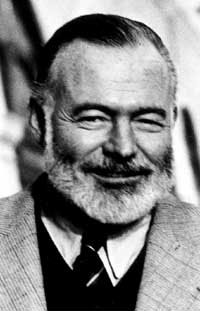
The Hemingway App is a new app designed to make "your writing bold and clear." When you enter a paragraph, it highlights errors, overly complex or confusing sentences, adverbs, overly long words, and passive voice. The theory is that by fixing problematic sentences you can achieve the famous terse style of Ernest Hemingway. The verdict on the Hemingway App is very mixed. An NPR article claims that the first paragraph of The Sun Also Rises would have been better if Hemingway had used the app to clear out some useless adverbs, but a similar article in the New Yorker claims that the app is a useful tool only when combined with the judgement of a writer to decide when the rules do indeed need to be broken. I would agree with the New Yorker on this. It is true that many writers have trouble "killing their darlings" (a quote attributed to many writers but with a surprising origin) and simplifying their prose. I know I often need to simplify and clarify what I write. But as one blogger showed by entering several passages of finely written English into the app, sometimes the calculated efficiency of machines needs to be balanced with the emotional judgement of humans. The ending passage of F. Scott Fitzgerald's The Great Gatsby scored a 14 in the Hemingway App, categorizing it as merely OK, and in the comments section of the article, a bit of H.P. Lovecraft received the whopping score of 23 (a good passage is 10 or below). But those tests weren't really needed, were they? A writing machine will never replace human authors. Writing is the art of capturing a million perspectives on the human experience, like a million shards of the largest broken mirror in the world, reflecting the distorted universe back at us. A machine can never do this, and the best writers will never be misguided by what an app tells them, because they know how to make decisions about their writing that improve it without compromising its integrity (or, at least, I hope they do).
My question was, how would the Hemingway App feel about books that are written for children? No matter how old I get I will never get tired of children's books. Now that I've read books that are far more complex than Louis Sachar's Holes or the first few Harry Potter books, I sometimes find their directness off-putting. But I have found that the simple prose often conceals very real emotional complexity that is accessible to people of all ages. One of my favorite children's books is Gossamer by Lois Lowry. This book is enchanting and sweet, and it treats heavy issues in a way that is both thoughtful and comprehensible. I inserted one of its most direct paragraphs from the beginning of the book to be judged by the Hemingway App.
''Littlest One, whose name was sometimes shortened affectionately to simply Littlest, was working on this night with Fastidious, the one who had been designated her teacher. Littlest was very small, new to the work, energetic and curious. Fastidious was tired, impatient, and had a headache. She sniffed in exasperation.''
This passage scored an 11, only one point away from being acceptable. I expected it to be flagged for adverbs and passive voice, because what writer doesn't slip up and use these from time to time? But what I didn't expect was this: the first sentence was classified as college reading level prose. My sister and I both read this book at a young age and never had any trouble with it. It is sold as a kid's book and was written as a kid's book. Sure, that sentence has a lot of commas, and passive voice, and it's long. But when taken slowly, it's clear what it means to say. Perhaps reading level is better judged by the amount of deep thinking and introspection needed to truly comprehend a sentence, rather than the complexity of its punctuation. The following quote from Ernest Hemingway's Farewell to Arms successfully scored a 6 in the app, but can you imagine trying to understand this at the age of eight or nine?
''If people bring so much courage to this world the world has to kill them to break them, so of course it kills them. The world breaks every one and afterward many are strong at the broken places. But those that will not break it kills. It kills the very good and the very gentle and the very brave impartially. If you are none of these you can be sure it will kill you too but there will be no special hurry.''
I think that what the Hemingway App teaches us above all is that simplicity can be deceptive, and being clear doesn't necessarily entail being obvious.
More Reading on the Hemingway App:
http://www.hemingwayapp.com/
http://whyevolutionistrue.wordpress.com/2014/03/31/hemingway-app-judges-writing-badly/
http://www.newyorker.com/online/blogs/books/2014/02/hemingway-takes-the-hemingway-app-test.html
http://www.npr.org/blogs/theprotojournalist/2014/03/05/282887992/hemingway-doesnt-always-live-up-to-his-code
https://www.goodreads.com/work/quotes/4652599-a-farewell-to-arms
Image Credit:
http://www.nndb.com/people/790/000022724/loc-hemmingway-2.jpg

No comments:
Post a Comment