Translate

Friday, July 25, 2014

Laughter's Not the Best Medicine Anymore


Just the other day I was unhappy and had no idea why. I lay on my bed in my dorm and stared at the ceiling. I didn't feel like reading, writing, watching TV, or actually getting up and getting dressed. I didn't feel depressed or hurt or sick or lonely, I just felt bad. So finally I forced myself to get out of bed and put on some clothes. I grabbed my journal and I went for a walk.

Salem College has a beautiful campus, and the walk itself was probably somewhat healing for me. It had just rained, so the humidity was gone for a while, and I walked along past red brick buildings that had been there for hundreds of years, and then down the sidewalk under the shade of trees until I reached the coffee shop. I found the most private place I could with my tea, at a table outside, and I started to write. I hadn't been away from the eyes of people I knew and whose opinion I cared about in days, so just being alone at that table lifted a weight off my shoulders. I wasn't checking my phone, and I felt strangely absorbed in my surroundings. A Segway tour came rolling into the parking lot, and a woman in an electric wheelchair came over to talk to the owner of the tours, who also owned the coffee shop. Out of the corner of my eye I could see that she was wearing colorful, mismatched socks. The conversation floated to her life story, and she said she had moved from Bangladesh when she was thirteen and lived in Asheboro, NC, the place with the zoo.

While all of this happened at the edge of my consciousness, I wrote. I wrote about everything that had happened the day before, but not in a way intended to capture every detail for posterity. My focus was emotional. What had happened that day to leave me with such a confusing bad feeling in the pit of my stomach? I wrote and wrote, following every idea that came to my head, but with no real design or plan. I was lost, the only thing I could rely on to guide me was some part of me that knew the truth but would only reveal it slowly. The thoughts coming to me seemed to be leading me in a particular direction, so I followed. And eventually, writing achieved for me what it does at the best of times. It broke through my confusion and helped me heal.

Why does writing have this ability? Is it just a way of ordering your thoughts, or a way of releasing them? In a way it's the same as a tearful confession or ranting to a friend, except you don't have to worry about having someone you trust to talk to, or losing their good opinion. A piece of paper isn't going to judge you.

M. Shannon Hernandez of the Huffington Post writes about her own experience with journaling as a means to work through a difficult divorce. For her (and for me also) writing is a way to slow down thoughts and become present. Since humans can think faster than they can write, writing forces a person to take the time to really process their thoughts. For me, this helps catch jumps in my thinking process. When I am drawing illogical conclusions, I realize that they don't make sense on paper. And when I slow down, I can separate my thoughts from my emotions. The other benefit that Hernandez highlights is the ability to recognize patterns. She kept a continuous journal and was able to go back and read previous entries to notice patterns that she created in her life, and from there was able to correct her behavior to avoid continuing in circles.

Writing is also frequently cited as a means to overcome trauma. Psychologist Dr. James W. Pennebaker has studied writing as a method of healing and written several books on the topic. He views writing as a way to take a step back from life and view it in a more coherent manner. The people who benefit the most from writing, he says, are those that can form a coherent narrative out of a confusing event, view it from different perspectives, and use language that shows complex thinking such as ''except'' and ''without.'' His exact method of using writing to overcome stressful or traumatic experiences is this:


He states that people who have undertaken this exercise have had improved health, changed the courses of their lives, and even gotten better grades. The idea that writing can change something inside of you that radiates into all areas of your life is one I truly believe. Writing is a way to take everything that is confusing and make something orderly, to take everything that is spinning so fast you can't keep track of it, and make it into something peaceful and still. It's a way to see the past laid out in front of you in your own words, and finally understand the inner workings that influenced previously incomprehensible events. On her blog Writing and Healing, Diane Morrow gave this poem as the reason she writes, and it truly touched me. This poem is what writing can be for me, and it's how I want to live my life:

The Guest House
This being human is a guest house.

Every morning a new arrival.

A joy, a depression, a meanness,

some momentary awareness comes
as an unexpected visitor.

Welcome and entertain them all!

Even if they are a crowd of sorrows,
who violently sweep your house
empty of its furniture,
still, treat each guest honorably.
He may be clearing you out
for some new delight.

The dark thought, the shame, the malice.

meet them at the door laughing and invite them in.

Be grateful for whatever comes.

because each has been sent
as a guide from beyond.

-- Jelaluddin Rumi,

    translation by Coleman Barks


More resources about writing and healing:
https://www.utexas.edu/features/2005/writing/
http://www.oneyearofwritingandhealing.com/
http://writingandhealing.org/
http://www.psychologytoday.com/blog/overcoming-child-abuse/201103/writing-and-healing
http://www.psychologytoday.com/blog/stop-walking-eggshells/201211/heal-writing-about-your-trauma
http://www.huffingtonpost.com/m-shannon-hernandez/journaling_b_4171453.html
http://www.apa.org/monitor/jun02/writing.aspx

Image sources:
https://www.utexas.edu/features/2005/writing/
http://i.cdn.turner.com/cnn/2011/HEALTH/06/29/writing.healing.enayati/t1larg.writing.healing.enayati.ts.jpg

Friday, July 18, 2014

Contemporary and Cool


I'm not in college and I'm not really a literary expert, let alone a pretentious writer type who judges a poem by how ugly it is. But I thought I should get an idea of what people are writing nowadays, just because it's cool, and also for inspiration and to share with anyone who wants to know. So here are some contemporary online literary magazines and examples of their writing!

100 Word Stories
This title is pretty self explanatory. This magazine only accepts stories and essays of 100 words or less because this "forces the writer to question each word.'' 

Here is the coolest story I saw while I was browsing. It was the second place winner in the magazine's National Flash Fiction Day contest:

Night-time Knitting
By Roz Mascall
A gorilla is living in my cupboard. Every night, he swaggers onto my bed and waits for me to wake-up. I pretend to be asleep but hear his knitting needles clicking together. He is making a very long scarf for me. Squinting at him from under my blanket, I see his huge hairy hands scratch his scalp in disappointment. He looks sad. A pang of guilt hits me. I sit up and he hands me a ball of pink wool. His watery eyes meet my gaze. He is lonely. We lean against each other and knit until sunrise.

I don't know why this story struck me as much as it did. It's simple, and while it has elements of the impossible, the tone is so matter-of-fact that it just seems sad rather than strange. And there is something beautiful about comforting a sad gorilla who is kind enough to knit you a scarf. Other good titles from this magazine are That's Not Love? by Jon Sindell and Thicker Than Water by Jean-Luc Bouchard.

1966
1966 is a journal that focuses on creative nonfiction, or, in their words, "prose that turns information into story and facts into art.'' I personally love creative non-fiction, but I didn't have enough time to read a lot of examples from this journal because they're a few pages long each. I did read one though, called These Orbits, Crossing by Miya Pleines. It was a beautiful, beautiful essay and I suggest you all read it!

I also read a few poems from the magazine 32 Poems but I'm not very good at judging poetry and sometimes get confused when it's abstract, so I'll just say that I liked the following poem, though I can't really say why:
Your Server for This Evening
By: Sarah Rose Nordgren

I slice a wedge of lime, slitting
the center so it holds to the glass.

I wipe the frost from the lip
of the plate with a cloth,

then touch it to my face, tenderly.
What you ordered was

specific, but you are patient
while I travel to the freezer,

searching out your favorite meal.
You are able to discern

between blue ice and blue-gray
ice with your eyes closed.

I know your habits better than
you know my name and your palate

is the bible from which I learn
my verses. How you cover

your lap with the napkin and
which bones you taste first

from the sugar skeleton,
show me that you are a gentle,

lonely person. No wonder
you pay so handsomely for

my company—you think I need
another reason to adore you.

So that's it for literature for today! Hopefully soon I will be performing at an open mic with a poem I wrote, and I'll write a little bit about what it's like to read poetry out loud to a bunch of random people you kind of know.

Thanks to the following websites for writing, info, and images:

Monday, July 14, 2014

What Inspiration Created


Here is what I wrote after being inspired at the dance. I edited it and feel better than I did before, but it's really just a flash of a moment that I hope I captured well.

Last night I danced with a fox in a Cleopatra mask of gold and black. We were in a circle of four, and her nose was always turned up to the air seeking something. She sought a larger group of dancers, a louder bunch of girls, fancier dresses and the heat of the center of the crowd. She wanted her hands to touch the body of the boy who danced on the hands of the crowd for a moment. She wanted to follow the shifting patterns until she reached some sort of end where everything was bright and permanent. Every time she approached something with excitement, hands outstretched, it melted. The boy who danced and flicked his suspenders trotted away. The girl who wasn’t afraid to move any part of her body laughed and left. The ones who moved too fast for her to do anything but look at them longingly flashed by. She didn’t have her finger to the pulse, but that heartbeat pounded in her ears. I couldn’t see her eyes behind that mask and it seemed as if she couldn’t see me at all. She was seeing the world in heat vision, but we in our circle were dancing like pebbles, senseless to the warmth. Insensible, but light. We danced slowly and still had the cores of ourselves when the music stopped. Beneath our masks we still had eyes and we had seen each other all along. I even imagined I could see the fox’s eyes now under Cleopatra’s golden face, but it might have been a trick of the light. The night deflated and so did she.

I don't know this person very well but I do like her very much, and this isn't meant to be a negative portrayal. It's just something that struck me that night.

Image Credit
http://www.nolaimports.com/store/images/neworleans-saintsmask.jpg

Inspiration


I'm not as good about writing as I should be. Writing relieves my soul in a way, it takes off the weight of things I have wanted to say but haven't, and I end up with words that will someday, after they've sat unread for an appropriate amount of time, give me happiness. So I should do it more. But sometimes I sit down and I feel like I've forgotten how to write, or like my feelings are so generally confused that I can't even pull out an emotion or two to string into sentences to create something. I also feel the pressure of writing exceedingly well. I feel like I have to make masterpieces with every stroke of my pen. I make no allowances for off days, first drafts, or other such things. When I allow myself to write for the simple pleasure of it I later critique and criticize and proclaim that what I have written is simply empty and ridiculous. I feel that I shouldn't write until I've become sufficiently good at it. But that will never happen, will it, unless I allow myself to write? I guess, in a way, I'm waiting for inspiration. But inspiration can't be predicted. And to be honest, I don't know what it is. What is inspiration?

The last time I felt a random inspiration was just a few nights ago. I was dancing with a group of other girls, and we were all dressed for a masquerade. We were all of us shy and not good at dancing. We moved sort of stiffly and gave each other awkward looks. One of us, though, was looking for something. She wasn't happy to dance with us in our group, she wanted to find where the most action was. She couldn't quite see out of the eyes of her mask so her head was tilted up, and it looked like she was sniffing the air to find the most interesting place to go. I wanted to write her into a character right then and there, not just the way she was at the dance but the way she was all the time. Something about her at that dance just completed her personality. The next day I wrote about that dance. I don't think I did it well because I wrote only about the dance and not about how she was as a whole. I thought I could write just about her sniffing the air for action, but it was just a puzzle piece in who she is. And to be honest, I didn't realize that until just now, so I have a whole new inspiration to write about.

Anyway, I guess I got a little off track. What I mean to write about is what exactly is inspiration? So many writers, or artists in general, wait for it. But waiting is the wrong approach. I think recently and for a while I've been waiting to write something good. Maybe I should just give myself the time and make myself write. So obviously I'm not the expert on this, but writers who are experts have lots of expert advice. Most of the things are pretty simple, and will improve other areas of your life besides your writing ability. I just finished one of the most difficult school years of my life and moved straight on to an academic, five-week summer program. Besides that, this year of my life has been the most eye-opening I have ever been through. Some combination of the classes I've taken and the people I've gotten to know has taught me that the world isn't exactly as I thought it was. So in total, I've been stressed and overwhelmed for so long. So why didn't I write? I guess I just didn't give myself the time.

So here's how to not be like me, and not avoid writing! The following tips are from the blogs Write to Done (the first four) and Live Write Thrive (the rest). For more of their tips, check out the blogs!


  1. Overheard dialog. If I’m anywhere public, whether it be at a park or a mall or my workplace, sometimes I’ll eavesdrop on people. Not in a gross way or anything, but I’ll just keep quiet, and listen. I love hearing other people have conversations. Sometimes it doesn’t happen on purpose — you can’t help but overhear people sometimes. If you happen to overhear a snippet of interesting dialog, jot it down in your writing journal as soon as possible. It can serve as a model or inspiration for later writing.
  2. Art. For the writer aspiring to greater heights, there is no better inspiration that great art, in my experience. While it doesn’t compare to the experience of seeing the art in person, I like to find inspiring works of art and put it on my computer desktop for contemplation (Michelangelo’s Pieta is there right now). It doesn’t have to be classical works, though — I’ve found inspiration in Japanese anime, in stuff I’ve found on deviantart.com, in local artists in my area.
  3. Writing journal. I highly recommend this for any writer. It doesn’t have to be fancy, or something you write in every day. Just a plain notebook will do, although a nice journal can be motivating. Write down thoughts and inspirations and quotes and snippets of good writing you find and pieces of dialog and plot ideas and new characters. Then go back to this journal when you need ideas or inspiration.
  4. Breaking your routines. Get out of your rut to see things from a new perspective. If you usually take one route to work, try a couple others. If you usually get up, get ready for work, and leave, try exercising in the morning or watching the sunrise. If you usually watch TV at the end of the day, try reading or writing instead. Shake things up.
  5. Meditation. Are you finding no ideas at all? Just try to relax and think of nothing. This is the moment when inspiration may come, and new ideas can sometimes appear unexpectedly.
  6. Take a look at something green or blue. Researches claim that these two colors can influence our creativity. It happens because we associate a blue color with sky or ocean (openness in general), and a green color gives us signals of growth.
  7. Engage in sports. During exercise, we not only strengthen our body but also liberate our brain. In addition to the physical benefits, we also develop better willpower, patience, and a sense of purpose.
  8. Do not wait for a muse. If you have already tried all the methods described above but your inspiration has not come back yet, start writing anyway. At some point your muse will approach from your back and peek over your shoulder, wondering what you are doing without her. Then, she will give you one hint. And then...she will take your hand softly and lead you to the place of inspiration.
I think my own writing advice would be this:

1. Don't censor yourself. Sometimes if you start writing imagining all the people who might someday read what you're writing, you try and write in a way that will please (or at least not upset) this future imaginary audience. I know I do that, maybe it's just me! But if you're writing, don't be afraid to say whatever you want to.
2. Make yourself feel cool. Sometimes I like to write best when I'm wearing a dress, sitting in a coffee shop with an iced tea, and I have a really thick notebook full of blank pages. Maybe this doesn't exactly make my writing better, but it's fun and it seems to make writing a little easier.

So that's it for inspiration! Maybe I should go take some of my own advice. 

The two blogs that helped me:

Thursday, July 10, 2014

Spotlight on Poetry


Right now, I am at Governor's School on the campus of Salem College. A few days ago, a man named Darryl Hunt came to speak to us about his life. Mr. Hunt was sentenced to life in prison at the age of 19 for a murder that he did not commit. Through continued injustice and racism in the judicial system he remained in prison for 19 years even though his innocence was clearly shown and the prosecution's case was obviously flawed. Having him speak to us about this was an amazing experience, and for many people here, a shocking one. We discussed it in one of my classes, and many people expressed their shock, anger, gratitude, and in some cases hopelessness regarding Mr. Hunt's speech and the justice system in our country. After the discussion, our teacher told us that she had a poem that she always read when she was feeling hopeless, to dispel those feelings and stay strong. She read it to us, and then we left the class in silence. Here is the poem she shared with us:

A Litany for Survival
By: Audre Lorde

For those of us who live at the shoreline
standing upon the constant edges of decision
crucial and alone
for those of us who cannot indulge
the passing dreams of choice
who love in doorways coming and going
in the hours between dawns
looking inward and outward
at once before and after
seeking a now that can breed
futures
like bread in our children's mouths
so their dreams will not reflect
the death of ours:

For those of us
who were imprinted with fear
like a faint line in the center of our foreheads
learning to be afraid with our mother's milk
for by this weapon
this illusion of some safety to be found
the heavy-footed hoped to silence us
For all of us
this instant and this triumph
We were never meant to survive.

And when the sun rises we are afraid
it might not remain
when the sun sets we are afraid
it might not rise in the morning
when our stomachs are full we are afraid
of indigestion
when our stomachs are empty we are afraid
we may never eat again
when we are loved we are afraid
love will vanish
when we are alone we are afraid
love will never return
and when we speak we are afraid
our words will not be heard
nor welcomed
but when we are silent
we are still afraid

So it is better to speak
remembering
we were never meant to survive

I fell in love with this poem the first time I heard it and I took it straight to my philosophy class. That day we were supposed to bring in something we thought was beautiful, and explain why we thought it was beautiful. So I shared this poem, and I said it was beautiful because it's about fear. Everyone in the world has fear of something. I think my greatest fear is of instability and change. But the best experiences we have are sometimes those that we reach by doing something we are afraid of. I think this poem also speaks more specifically to people whose fear is present in the simple fabric of their life, who are often truly not safe or secure. The author, Audre Lorde, was a lesbian, African-American woman who used her poetry to fight against the discrimination and marginalization she faced because of the various aspects of who she was. She truly spoke from her own life when she wrote, So it is better to speak/remembering/we were never meant to survive

Image Credit:

More information on Audre Lorde and her works:


Tuesday, July 8, 2014

The Deception of Language


*WARNING: the following post contains bias*
But then again, what doesn't?

I would say that I am, first and foremost, a creative writer. I don't often delve into the realm of the research paper or news article. But the world of informative writing is, I think, just as intricate and fascinating as the world of creative writing. Writing even the most straightforward blurb in a newspaper requires skill, even if it is the skill of restraint more than the skill of expression. The main difference between a creative and informative piece is the amount of subjectivity we expect.

Right now, I'm using the term ''informative writing'' rather broadly. Informative writing is actually distinct from expository writing; the former is simply the impartial presentation of information, while the second may include opinion or bias, though it is expected to be backed up with some sort of proof. Interestingly, an article I read about the difference between these two types of writing listed newspaper articles under expository writing. How can that be true? When we read the newspaper, don't we expect to find an entirely unbiased account of the events in the world? Which of course raises the question, can a human write without bias? And what does an unbiased account actually look like? I decided that this was an interesting (and important) question to explore, so I looked up the definition of bias.

The Oxford Dictionaries defined bias as: ''Prejudice in favor of or against one thing, person, or group compared with another, usually in a way considered to be unfair.''

Naturally, humans are raised in environments and have experiences that form their ideas and beliefs. For example, if you are raised in a particular religion, your faith in the teachings of a religious leader influence your actions and how you relate to the world. I don't believe it is possible to relate to the world in an unbiased way. In a philosophy class I am taking, the teacher asked us what it means to be unbiased, and whether or not such a state can be achieved. Some of us reached the conclusion that it is impossible to be unbiased since that would require understanding and having no preference among every possible perspective on an issue, but that a person can become closer to eliminating their bias by examining and trying to understand as many separate biased viewpoints as they can. I don't know if this is true or not, but it seems like a good theory to apply to journalism.

A journalist can not be without bias. Say he or she arrives at a protest with the intention of collecting information and writing an informational account of the event. This account isn't unbiased unless the journalist interviews every person in attendance, every spectator, and anyone that is involved in any way. By selecting two or three people to interview (say, a leader of the protest, the person they are protesting against, and one spectator), he or she is favoring their opinions over the opinions of many other people and therefore showing bias. This isn't to say that the journalist's work is bad or wrong. The definition of bias outlines it as prejudice that is considered to be unfair. If the journalist interviews three people who are representative of the three main groups involved in the protest, he or she is not being unfair. While the journalist's article may not be purely informative, it is as close to unbiased as a human can come within the limits of reason.

Of course, bias is also represented more obviously in language and in the way a piece is written. Some pieces are meant to include bias, such as editorials and opinion pieces, but the danger comes when an author claims to be neutral while using subtly leading language. An organization called Accuracy In Media (AIM) gives several examples of language that expresses opinion without overtly stating it, such as using the phrase to "steal'' a page from someone's book rather than to ''take'' a page from someone's book. This shifts the connotation of the sentence to negatively represent the person doing the action (in this case, President Bush). It is important to note, however, that while AIM makes several valid and important points about bias in media (saying that language can not be used without bias, so the bias must at least be minimized and acknowledged), they themselves express bias by only correcting language that goes against their political beliefs. In fact, the majority of their own news reports center on specific political beliefs and have inflammatory, connotative headlines.

Why is it important for media to be unbiased? Because we rely on the media to shape the way we see the world. Not everyone has access to the information and/or resources that journalists have, so we rely on what they tell us to shape our opinions on politics and other important facets of life. The truth, however, is that the media is not neutral. Humans are limited by their own experience, and journalists often bring bias to the table beyond what is necessary. So as people trying to understand the world, it is important that we follow the (somewhat hypocritical but still applicable) advice of AIM and "be mindful'' of the language used in the media we consume. We need to consider what is said, what is left unsaid, and which words seem highly connotative. There has always been bias of some sort in the media. "Yellow journalism" during the Spanish-American war, newspapers for every political party that has ever existed, and of course the gap between Fox and MSNBC today. But if we acknowledge the inherent bias of the media and still accept their information without further thought, we are becoming more biased rather than more informed.

An example of my own (biased) expository writing from a school project:
whrhatigan2014.blogspot.com

Saturday, July 5, 2014

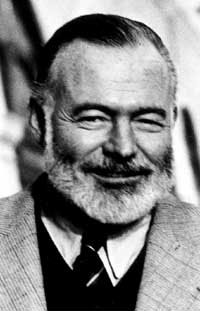
Hemingway for Kids


The Hemingway App is a new app designed to make "your writing bold and clear." When you enter a paragraph, it highlights errors, overly complex or confusing sentences, adverbs, overly long words, and passive voice. The theory is that by fixing problematic sentences you can achieve the famous terse style of Ernest Hemingway. The verdict on the Hemingway App is very mixed. An NPR article claims that the first paragraph of The Sun Also Rises would have been better if Hemingway had used the app to clear out some useless adverbs, but a similar article in the New Yorker claims that the app is a useful tool only when combined with the judgement of a writer to decide when the rules do indeed need to be broken. I would agree with the New Yorker on this. It is true that many writers have trouble "killing their darlings" (a quote attributed to many writers but with a surprising origin) and simplifying their prose. I know I often need to simplify and clarify what I write. But as one blogger showed by entering several passages of finely written English into the app, sometimes the calculated efficiency of machines needs to be balanced with the emotional judgement of humans. The ending passage of F. Scott Fitzgerald's The Great Gatsby scored a 14 in the Hemingway App, categorizing it as merely OK, and in the comments section of the article, a bit of H.P. Lovecraft received the whopping score of 23 (a good passage is 10 or below). But those tests weren't really needed, were they? A writing machine will never replace human authors. Writing is the art of capturing a million perspectives on the human experience, like a million shards of the largest broken mirror in the world, reflecting the distorted universe back at us. A machine can never do this, and the best writers will never be misguided by what an app tells them, because they know how to make decisions about their writing that improve it without compromising its integrity (or, at least, I hope they do).

My question was, how would the Hemingway App feel about books that are written for children? No matter how old I get I will never get tired of children's books. Now that I've read books that are far more complex than Louis Sachar's Holes or the first few Harry Potter books, I sometimes find their directness off-putting. But I have found that the simple prose often conceals very real emotional complexity that is accessible to people of all ages. One of my favorite children's books is Gossamer by Lois Lowry. This book is enchanting and sweet, and it treats heavy issues in a way that is both thoughtful and comprehensible. I inserted one of its most direct paragraphs from the beginning of the book to be judged by the Hemingway App.

''Littlest One, whose name was sometimes shortened affectionately to simply Littlest, was working on this night with Fastidious, the one who had been designated her teacher. Littlest was very small, new to the work, energetic and curious. Fastidious was tired, impatient, and had a headache. She sniffed in exasperation.'' 

This passage scored an 11, only one point away from being acceptable. I expected it to be flagged for adverbs and passive voice, because what writer doesn't slip up and use these from time to time? But what I didn't expect was this: the first sentence was classified as college reading level prose. My sister and I both read this book at a young age and never had any trouble with it. It is sold as a kid's book and was written as a kid's book. Sure, that sentence has a lot of commas, and passive voice, and it's long. But when taken slowly, it's clear what it means to say. Perhaps reading level is better judged by the amount of deep thinking and introspection needed to truly comprehend a sentence, rather than the complexity of its punctuation. The following quote from Ernest Hemingway's Farewell to Arms successfully scored a 6 in the app, but can you imagine trying to understand this at the age of eight or nine?

''If people bring so much courage to this world the world has to kill them to break them, so of course it kills them. The world breaks every one and afterward many are strong at the broken places. But those that will not break it kills. It kills the very good and the very gentle and the very brave impartially. If you are none of these you can be sure it will kill you too but there will be no special hurry.''

I think that what the Hemingway App teaches us above all is that simplicity can be deceptive, and being clear doesn't necessarily entail being obvious. 

More Reading on the Hemingway App:
http://www.hemingwayapp.com/
http://whyevolutionistrue.wordpress.com/2014/03/31/hemingway-app-judges-writing-badly/
http://www.newyorker.com/online/blogs/books/2014/02/hemingway-takes-the-hemingway-app-test.html
http://www.npr.org/blogs/theprotojournalist/2014/03/05/282887992/hemingway-doesnt-always-live-up-to-his-code
https://www.goodreads.com/work/quotes/4652599-a-farewell-to-arms

Image Credit:
http://www.nndb.com/people/790/000022724/loc-hemmingway-2.jpg


Friday, July 4, 2014

Oh Crap, Valentine's Day Is Only 7 Months Away!


I know it's not Valentine's Day, but it's never too early to start planning the perfect poem for someone special. Hopefully this won't turn into a corny lesson on writing Valentine's rhymes because, well, it's July. But really, love isn't restricted to any holiday, so love poems shouldn't be either. 

Before I write this, I have to make a confession. I'm sixteen, I've only dated one guy ever, I've never actually had my heartbroken and I'm probably very naive. But hey, a little optimism and innocence is always good. I was inspired to write this entry because I was inspired to write a poem. I was walking along in a grassy square and suddenly a few lines popped into my head. I scrambled in my purse to find a program from a dance performance and a pen, stopped at a bench, and began to write. Whenever I've tried to write a love poem it never worked. This is the first time I ever have, but it means more to me than any poem I've ever written. I can't say it's the best one I've ever written, and the more I read it the less confident I am about it. But I didn't write it to impress anyone with my poetic genius, I wrote it to make one person in the world smile, and I did.

Origami 

You go through life tucking in corners
Making the world neat as you want it to be
You tuck in the corners of your heart
So I can fit inside cozily.
As much as I love the warm home you make
I can't control my bony elbows and knees
I poke you and jab you without ever knowing
I'm hurting you where you feel it most painfully.

But as you make beds with the sheets folded just so
And I leave my blankets a tangled mess
There's room for me to tuck in a corner here or there, although
There is also room to unfold your origami heart
and let the world you've so neatly tucked away come through.
With care you calm the edges that flare inside of me
and tuck your own pain and fear inside
So I must crawl inside of you to bring the light you need
to read your own heart by.

I have you and you me,
a bed only half made, one side tucked in
the other burst, my feet hang free
Somehow we both sleep comfortably
your origami heart and me.

I've never shared my writing online before, so all I can say is please don't plagiarize. This poem was written for one person and fits that person perfectly, it's not meant for anyone but him. I'm only putting it on here to show that sometimes love can be the best inspiration, but don't try to force it. A few months ago I tried writing a love poem, and I proudly showed it to my boyfriend. He told me it was good, but he seemed embarrassed. When I asked what was wrong he said, ''I don't get it.'' That was because I got so lost trying to make good metaphors that I forgot to make it much of a poem at all. 

But as I said, I'm no expert on love. So let's call in the experts! The Poetry Foundation and later Huffington Post published the same interviews with a series of poets on how to write love poems without dipping too far into the cliche and vague and trite. Maybe the poem I wrote is all three of those things, but it feels deeply true to me, and it is far simpler than what I have tried to write before, which I think reveals its trueness; I had no need to make it prettier with more extensive metaphors.  

Anyway, here is some advice from experienced poets on how to write about love without sounding like a Hallmark Card (also, read their poetry. It's good.): 


  • Adrian Blevins said rather intensely that ''bad love poetry is bad because it is trite. Triteness is bad because it’s untrue, and untrueness is bad because it is a waste of time and energy and, somehow, unjust.'' Her love poem "The Way She Figured He Figured It" is certainly not trite. Maybe I'm just a trite person, or naive, but it felt very unromantic to me. I do agree with her that being trite is untrue, but it's a difficult thing to avoid though because, as the poet Craig Arnold said, "what is a cliche, if not a poem that won?"
  • Rebecca Hoogs advocates living on the edge, saying ''a good love poem lives in a tense state. If there’s no tension in the love, there’s no tension in the poem. 'I love you, you’re perfect,' no matter how prettily said, is boring.''
  • And lastly, Craig Arnold. What he said touched me the most, I think because it is the most love-y. His poem "Bird-Understander'' is simply beautiful. He said he wants his poetry to say, '''Listen, what you said to me, it’s already poetry, better than anything I could write, and it would make me happy simply to have you see that.'''
Of course, if you really need a poem pronto (for example, when it's seven hours and not seven months until Valentine's Day) you can always use the simple steps provided on wikiHow such as "be brave'', ''brainstorm'' and ''refine presentation (optional).'' Maybe this won't result in anything groundbreaking or revolutionary, but does that really matter? The more I read love poems and think about them, the more I pick at my own. I could have been less cliche, I shouldn't have made it rhyme. But what is the point of love poetry anyway? I think there are two purposes. One is to capture a complex, indescribable, painful, and beautiful emotion. My favorite love quote is from the movie Stardust: ''I know that love is unconditional. But I also know that it can be unpredictable, unexpected, uncontrollable, unbearable and strangely easy to mistake for loathing.'' Love isn't easy, so a love poem shouldn't be easy either. But for anyone out there who is trying to make someone feel special and loved, as long as you are as brave and honest as you can be, a few too many adjectives will be quickly forgiven.


For more love interviews, poems, and quotes:

Empty Words


The last time I wrote, I was trying to convince myself as much as I was trying to convince anyone else. As much as I believe writing should be relaxing and fulfilling, I sometimes feel like the things I write don't have enough truth to be considered meaningful. It's easy to sit down and write a story that sounds pretty, but often the things I write do nothing more than sound pretty. Perhaps for me, this is because I shy away from writing when I am feeling any overwhelming emotion. I am afraid that writing will reveal something I don't want to know. When I am dizzyingly happy, I don't want to burst my own bubble by examining it. When I am feeling worse than I ever have, I just want to curl up in self pity without searching for the cause of or solution to my problems. Writing can act as a scalpel, cutting through the layers of self deception in your life and piercing right to the truth. But as humans we deceive ourselves for a reason, trying to hide among false truths to avoid what is most painful.

Unfortunately, when I write in ways that prop up my own self deception, the writing is just drifting along the surface of a very deep pond. It might sound nice to me, but it means little to anyone else. And when I really think about it, it's empty to me too. Like a painted eggshell with the yolk blown out, it won't fill anyone's hunger for insight, truth, or even a good story.

I have had a lot of writing teachers, for better or for worse. At times I feel like I have learned so many rules about writing (don't use adverbs, be pithy, use original vocabulary) that I overthink everything I write. But the one piece of advice I have been given that is universally true and applicable to any writer that aspires to write something truthful is to write consistently. Write every day for fifteen minutes at least, just sit down and write for hours, don't worry about if it's good enough, just keep writing until you hit a truth, and then follow that vein for as long as it inspires you.

For the past two weeks I have been at an academic summer camp, and I've wanted to write. It began when I was feeling homesick and upset. I wanted to write but I was scared to approach my emotion directly, and didn't know how. So I wrote a fable about a girl who drinks a potion so she can fly away from her empty home. She finds romance and a happy life, but it's not a thrilling story. It's slow paced and melancholy. To me, this story doesn't feel empty. There is something alive inside of it that brings up true emotions. But the next day I had the continued urge to write, so I walked half a mile to a coffee shop and sat there for two hours, scribbling away and drinking iced tea. I came up with a strange story that was interesting, fun to write, but ultimately empty. It was melodramatic, and its strangeness wasn't excused by any sort of purpose. It was fun, but I felt let down by the outcome.

So what is the point of all this? I guess it is to say that not all writing has to be perfect, and not all writing has to be emotional. The second story that I wrote wasn't a great work of literature (not that the first one was either). But I can't get the memory of that day out of my mind. I walked through the beautiful, red brick campus of Salem College in Winston Salem, North Carolina. It was a brilliantly hot day, and I sat on a bench, watching a couple eat fast food and laugh on a nearby bench. I tried to write there, but was so bothered by mosquitoes I went on the trek down to the coffee shop, sometimes pausing on the way to write down an idea that struck me. Soon I was sitting at a table in a cool, air-conditioned room, scribbling and only pausing to take sips of green tea. For the past two weeks I had been surrounded by people all the time, and I felt pressured to make friends and be social. For an introvert like me, this was indescribably stressful. As I wrote I felt that stress slipping away. I felt calmer than I had in days, and I felt a certain pride in having taken matters into my own hands and having found a way to enjoy my weekend that was different from what everyone else was doing, but felt right to me. In this moment, the actual product of my writing was unimpressive. But the fun and peaceful afternoon it gave me was priceless.

Of course, I hope to someday be the kind of writer who wields words like scalpels. But I don't want to force myself, right now, to be something I'm not. After having a succession of writing teachers (all very good teachers with good advice), I came dangerously close to losing my love for writing. It felt like an art I could never measure up to. But I've slowly come to realize that the only advice I should follow is this: write consistently, write when you want to and when you don't, write every day, and never worry if it's "good" or not, because eventually you will hit on a truth that needs to be said, and that will certainly be worth every empty word you ever wrote.


Image Credit
http://elephantspaycheck.com/wp-content/uploads/2013/04/Empty-Words.jpg